Conversation Analytics
for AI Product Teams
Conversation Analytics
for AI Product Teams
The most intuitive way to identify AI agent failures, fix what matters, and ship improvements that delight your users.

Trust takes years to build.
And one bad response to break.
Trust takes years to build.
And one bad response to break.
Infrastructure monitoring can't see trust eroding. You notice when support tickets spike and users stop coming back.
Don't wait for your AI to go viral for the wrong reason
Don't wait for your AI to go viral for the wrong reason

Entropys's Beard
@Thebeardfiles
@K*********** support is truly the worst of any brokerage. You wait and wait and wait and wait for someone to call you. After going through their bs AI that does everything it can to not have someone call you. Oh and the ETA for someone to call you is utter bs.
Entropys's Beard
@Thebeardfiles
Its absolutely bonkers how bad the support AI chat bots are. I just had the worst experience with @A******, after starting the chat, I got asked at least 5 times for my email, only in the end to get a 48 hours response timer. Do better @A******
Entropys's Beard
@Thebeardfiles
M** customer service is the worst first you can't connect with the customer executive there is no option AI talk with u and this is worst thing i ever seen after tht anyhow i connect with the executive than 4 time call transfer to others & I hv to explain each @M*********
Entropys's Beard
@Thebeardfiles
@C******* provides no way to contact support other than interact with their AI agent. And it is the worst AI agent for support. It takes you in circles, points to irrelevant knowledge articles and doesn't understand you
Entropys's Beard
@Thebeardfiles
@K*********** support is truly the worst of any brokerage. You wait and wait and wait and wait for someone to call you. After going through their bs AI that does everything it can to not have someone call you. Oh and the ETA for someone to call you is utter bs.
Entropys's Beard
@Thebeardfiles
@K******** support is truly the worst of any brokerage. You wait and wait and wait for someone to call you. After going through their bs AI that does everything it can to not have someone call you. Oh and the ETA for someone to call is bs.
You're looking at the wrong conversations
You're scrolling through traces hoping something jumps out. So you fix whatever caught your eye, not what's actually breaking for users.
Your experts can't work with raw traces
SMEs can fix the issues. But they don't want to read raw traces, and you can't spend your life curating examples for them.
You're fixing problems that don't matter
You fix whatever problem you happened to notice. Not the ones actually hurting users.
You're fixing problems that don't matter
You fix whatever problem you happened to notice. Not the ones actually hurting users.
You find out from angry users, not data
Churn metrics tell you something broke. They don't tell you what, where, or when to fix it.
You find out from angry users, not data
Churn metrics tell you something broke. They don't tell you what, where, or when to fix it.
The conversation analytics layer
your stack is missing
The conversation analytics layer
your stack is missing
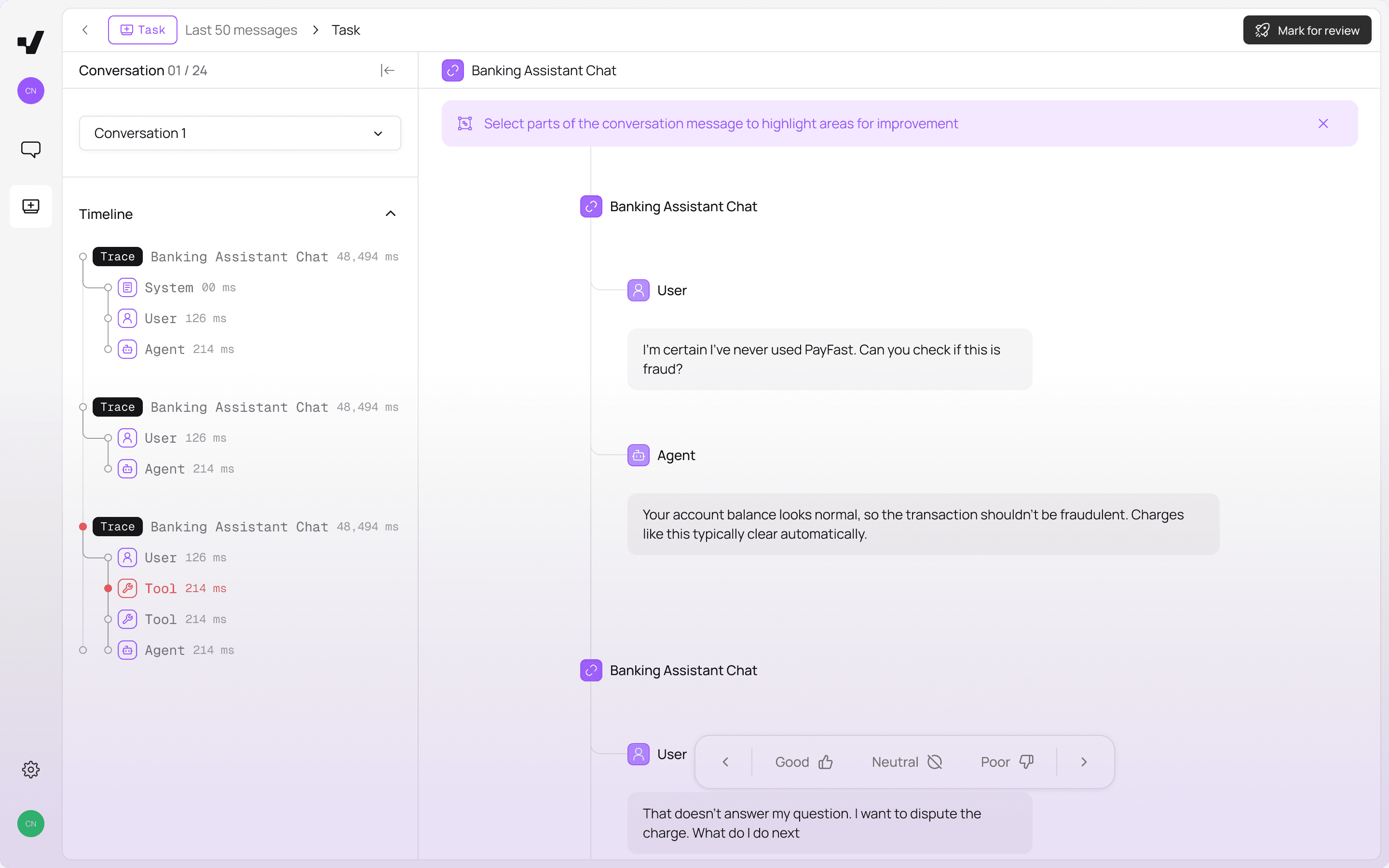
Verse finds the patterns in thousands of conversations that your team can't see manually.

Use fewer conversations to understand more
Verse automatically surfaces the interactions that matter: failed tool calls, user frustration, botched handoffs.
Get feedback from your team, safely and easily
Your team can spot friction, understand context, and share insights without exposing sensitive conversation data.
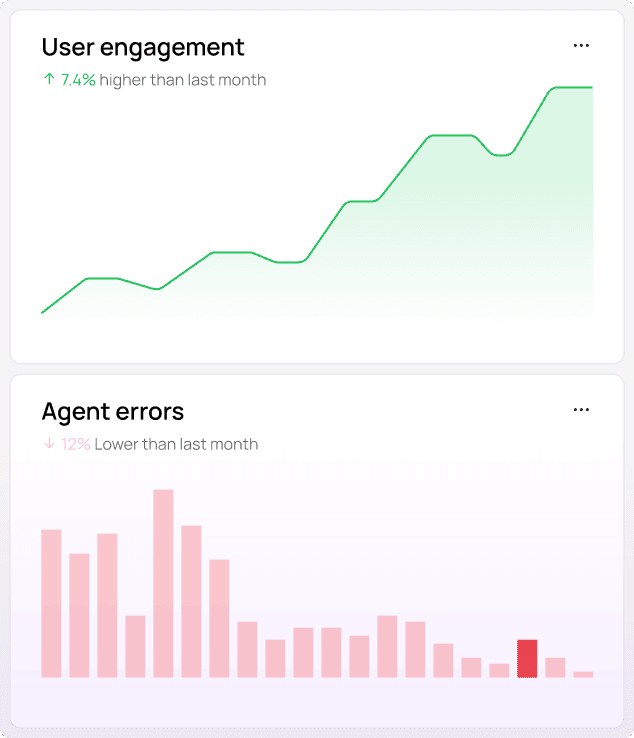
See your agent improve with every iteration
Clearly track performance gains and watch user experience strengthen over time.
FAQ
How does this fit into my AI SDLC?
Refining an AI product follows the same cycle as any product: identify issues in production, understand what's broken, make improvements, and validate they worked. Verse sits in this evaluation and continuous improvement phase (after deployment), when you need to systematically refine based on real user interactions. Most teams struggle here. Observability tools show what happened technically, but not why users struggled or which problems matter most. Verse structures this into three steps: Detect → Surface the user interactions that matter - not all 10,000 conversations, just the ones where users hit friction, dropped off, or didn't find value Collaborate → Get feedback from domain experts and engineers to identify what's actually broken, with a structure that makes it easy for people to provide useful input without another meeting Iterate → Understand which problems are most pressing based on patterns in the feedback, make improvements, then validate they actually improved user outcomes
Is Verse right for my company/product?
Verse works best for teams who have: - A customer-facing AI product in production with real users - Multiple people who need to weigh in on improvements (engineers, PMs, subject matter experts) - Tried coordinating this through spreadsheets, Slack, and meetings but it doesn't scale - Getting feedback but no systematic way to prioritize what actually matters If you're past the prototype stage and struggling to improve your AI product systematically, Verse is built for you.
How is Verse different from other options?
Most tools give you metrics (drop-off rates, sentiment scores) or technical traces (token counts, latency). Verse shows which conversations frustrated users and why. When your PM sees a drop-off spike, they're stuck manually reviewing hundreds of conversations to understand what's broken. When your domain expert needs to weigh in, you're exporting CSVs they can't actually use. Verse surfaces the conversations where users struggled and makes it easy for your whole team to review and provide feedback. Not generic sentiment analysis - your team teaching the system what quality means for your specific product. The result: you find problems proactively instead of through churn, and your whole team can contribute directly.
Where does Verse fit into my tech stack?
Verse complements your observability stack—it doesn't replace it. If you're logging traces with Langfuse, LangSmith, Datadog, or Braintrust, you can pipe that data into Verse. Observability tools answer "what happened" technically. This is great for engineers debugging specific executions. Verse answers "why users struggled in conversations" and "what to prioritize" by surfacing patterns across thousands of interactions and helping cross-functional teams focus on fixes that improve user experience. The key difference: when your PM or domain expert needs to understand where your conversational AI is breaking down, observability tools force you into CSV exports and coordination meetings. Verse eliminates that. Everyone reviews actual conversations and contributes directly.
What does getting started with Verse look like?
Sign up for the waitlist. We'll provide updates as we build, and you can contact our team directly during this period. We'll help you connect your traces and once connected, you can start surfacing issues and gathering feedback from your team immediately.
How does this fit into my AI SDLC?
Refining an AI product follows the same cycle as any product: identify issues in production, understand what's broken, make improvements, and validate they worked. Verse sits in this evaluation and continuous improvement phase (after deployment), when you need to systematically refine based on real user interactions. Most teams struggle here. Observability tools show what happened technically, but not why users struggled or which problems matter most. Verse structures this into three steps: Detect → Surface the user interactions that matter - not all 10,000 conversations, just the ones where users hit friction, dropped off, or didn't find value Collaborate → Get feedback from domain experts and engineers to identify what's actually broken, with a structure that makes it easy for people to provide useful input without another meeting Iterate → Understand which problems are most pressing based on patterns in the feedback, make improvements, then validate they actually improved user outcomes
Is Verse right for my company/product?
Verse works best for teams who have: - A customer-facing AI product in production with real users - Multiple people who need to weigh in on improvements (engineers, PMs, subject matter experts) - Tried coordinating this through spreadsheets, Slack, and meetings but it doesn't scale - Getting feedback but no systematic way to prioritize what actually matters If you're past the prototype stage and struggling to improve your AI product systematically, Verse is built for you.
How is Verse different from other options?
Most tools give you metrics (drop-off rates, sentiment scores) or technical traces (token counts, latency). Verse shows which conversations frustrated users and why. When your PM sees a drop-off spike, they're stuck manually reviewing hundreds of conversations to understand what's broken. When your domain expert needs to weigh in, you're exporting CSVs they can't actually use. Verse surfaces the conversations where users struggled and makes it easy for your whole team to review and provide feedback. Not generic sentiment analysis - your team teaching the system what quality means for your specific product. The result: you find problems proactively instead of through churn, and your whole team can contribute directly.
Where does Verse fit into my tech stack?
Verse complements your observability stack—it doesn't replace it. If you're logging traces with Langfuse, LangSmith, Datadog, or Braintrust, you can pipe that data into Verse. Observability tools answer "what happened" technically. This is great for engineers debugging specific executions. Verse answers "why users struggled in conversations" and "what to prioritize" by surfacing patterns across thousands of interactions and helping cross-functional teams focus on fixes that improve user experience. The key difference: when your PM or domain expert needs to understand where your conversational AI is breaking down, observability tools force you into CSV exports and coordination meetings. Verse eliminates that. Everyone reviews actual conversations and contributes directly.
What does getting started with Verse look like?
Sign up for the waitlist. We'll provide updates as we build, and you can contact our team directly during this period. We'll help you connect your traces and once connected, you can start surfacing issues and gathering feedback from your team immediately.
How does this fit into my AI SDLC?
Refining an AI product follows the same cycle as any product: identify issues in production, understand what's broken, make improvements, and validate they worked. Verse sits in this evaluation and continuous improvement phase (after deployment), when you need to systematically refine based on real user interactions. Most teams struggle here. Observability tools show what happened technically, but not why users struggled or which problems matter most. Verse structures this into three steps: Detect → Surface the user interactions that matter - not all 10,000 conversations, just the ones where users hit friction, dropped off, or didn't find value Collaborate → Get feedback from domain experts and engineers to identify what's actually broken, with a structure that makes it easy for people to provide useful input without another meeting Iterate → Understand which problems are most pressing based on patterns in the feedback, make improvements, then validate they actually improved user outcomes
Is Verse right for my company/product?
Verse works best for teams who have: - A customer-facing AI product in production with real users - Multiple people who need to weigh in on improvements (engineers, PMs, subject matter experts) - Tried coordinating this through spreadsheets, Slack, and meetings but it doesn't scale - Getting feedback but no systematic way to prioritize what actually matters If you're past the prototype stage and struggling to improve your AI product systematically, Verse is built for you.
How is Verse different from other options?
Most tools give you metrics (drop-off rates, sentiment scores) or technical traces (token counts, latency). Verse shows which conversations frustrated users and why. When your PM sees a drop-off spike, they're stuck manually reviewing hundreds of conversations to understand what's broken. When your domain expert needs to weigh in, you're exporting CSVs they can't actually use. Verse surfaces the conversations where users struggled and makes it easy for your whole team to review and provide feedback. Not generic sentiment analysis - your team teaching the system what quality means for your specific product. The result: you find problems proactively instead of through churn, and your whole team can contribute directly.
Where does Verse fit into my tech stack?
Verse complements your observability stack—it doesn't replace it. If you're logging traces with Langfuse, LangSmith, Datadog, or Braintrust, you can pipe that data into Verse. Observability tools answer "what happened" technically. This is great for engineers debugging specific executions. Verse answers "why users struggled in conversations" and "what to prioritize" by surfacing patterns across thousands of interactions and helping cross-functional teams focus on fixes that improve user experience. The key difference: when your PM or domain expert needs to understand where your conversational AI is breaking down, observability tools force you into CSV exports and coordination meetings. Verse eliminates that. Everyone reviews actual conversations and contributes directly.
What does getting started with Verse look like?
Sign up for the waitlist. We'll provide updates as we build, and you can contact our team directly during this period. We'll help you connect your traces and once connected, you can start surfacing issues and gathering feedback from your team immediately.
Ready to Start?
Sign up today to accelerate your AI product and start delighting your users.
The UX analytics
system for AI teams
Verse helps teams improve their conversational AI systematically. Find problems, get expert feedback, and make fixes without spreadsheets and meetings.